
How to Build Strategic Carrier Relationships That Protect Capacity | BlueWave Supply Chain
The Carrier Relationship Advantage Is Real: Here's How to Build It
Published by LeAnne Coulter | BlueWave Supply Chain
Originally presented at ISM World 2026 | Decoding the Transportation Market — Part 3 of 5
Think about how your organization manages strategic supplier relationships: the vetting process, joint business planning, quarterly reviews, shared data, mutual investment. Now ask yourself: Do you apply that same discipline to your transportation providers?
For most organizations, the honest answer is no. And in a tightening capacity market, that gap is about to become very expensive. You’re already seeing it in the market. Carriers have called relationship management “Shipper of Choice” for years. It’s time to address this gap. Let’s talk about what this means from a practical perspective.
Transactional vs. Strategic: The Difference When It Matters
When capacity gets tight, carriers allocate to strategic partners first. That's not altruism, it's business logic. It is also not a carrier forgetting or neglecting a shipper. If a shipper has invested in the relationship, shared data, maintained reasonable expectations, and paid on time, carriers will prioritize their capacity accordingly.
Here's what that looks like in practice:
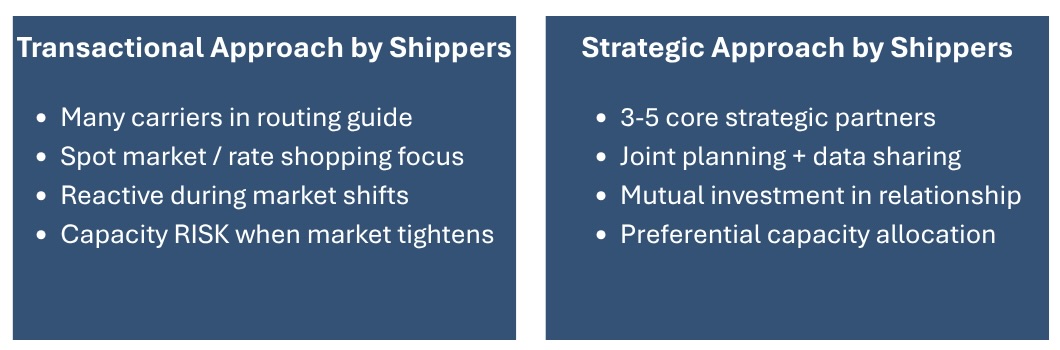
Chad Claude described this dynamic at ISM: a dedicated fleet relationship that worked not just because of the contract, but because of the governance structure, joint planning, and the fact that both parties understood each other's economics deeply.
Heidi DeMello raised the right question from the 3PL shipper perspective: How do you ensure your 3PL is building those strategic relationships on your behalf? If you're working through a third party, you need to be asking about their carrier vetting criteria, their carrier financial health monitoring, and how they handle disruption.
Three Questions to Ask Your Providers Today
"Show me your carrier vetting criteria." If your 3PL can't answer this in detail, that's a signal.
"How do you monitor the financial health of your carrier base?" Small carriers are exiting. Knowing your provider is watching for that matters.
"When capacity is tight, what's your prioritization logic?" You want to know where you stand before you need to know.
What Does the Audience Say?
At ISM, I asked the audience: How many of you review transportation performance with your providers quarterly in a similar manner that you would a material supplier?
The response was what I expected. Most organizations don't. Procurement teams that run rigorous supplier reviews in every other category treat transportation as a cost line to manage rather than a strategic function to optimize.
In a capacity-driven market, that mindset is a liability. Remember, transportation strategy is supply chain strategy. Without an intentional approach to managing relationships, you will see tender rejections and cost spike. Shipper of Choice isn’t a nice to have. It is a critical component to your transportation strategy.
Download the Transportation Market Decision Checklist
This is Part 3 of a 5-part series. Read Part 2: What's Really Under Your Freight Rate. Up next: Private Fleet vs. Dedicated vs. 3PL: The 2026 Decision Framework.
LeAnne Coulter is CEO & Founder of BlueWave Supply Chain. Connect at linkedin.com/in/leannecoulter or [email protected].