
Drowning in Data and Starving for Insight | BlueWave Supply Chain
Post 1.2"You're Drowning in Data and Starving for Insight"
Series 1: The Information Age Has Outpaced Leadership
Published by LeAnne Coulter | BlueWave Supply Chain
There is an uncomfortable irony at the center of modern business leadership. Executives today have access to more information than any generation of leaders in history. There are more data, research, real-time signals, and competitive intelligence at our fingertips. Yet the quality of organizational decision-making has not improved proportionally. In many organizations, it has quietly deteriorated.
This is not a paradox. It is a predictable consequence of a fact that most leadership development programs have never adequately addressed: more information, beyond a threshold, does not improve decisions. It degrades them.
Understanding why decisions degrade with more information is essential for any executive who wants to lead with clarity in today’s business climate. At the same time, we must understand the staggering scale at which information is now growing.
The Scale of What We're Dealing With
To appreciate the leadership challenge, it helps to start with the raw numbers, because the human mind tends to normalize what it cannot fully visualize.
Global data creation has grown at a rate that defies intuitive comprehension:
In 2020, humanity had generated approximately 64.2 zettabytes of data in total
By 2024, that figure reached 149 zettabytes
By the end of 2025, projections point to 181 zettabytes
By 2029, the projection is 394 zettabytes, more than a tripling in five years
A single zettabyte is one trillion gigabytes. To put the current daily generation rate in perspective: humanity now creates approximately 402 quintillion bytes of data every single day. More data is generated every two days than existed in total from the beginning of recorded history through 2003.
The concept that helps frame this trajectory is R. Buckminster Fuller's Knowledge Doubling Curve, first documented in 1982. Fuller observed that the rate at which human knowledge accumulated was itself accelerating:
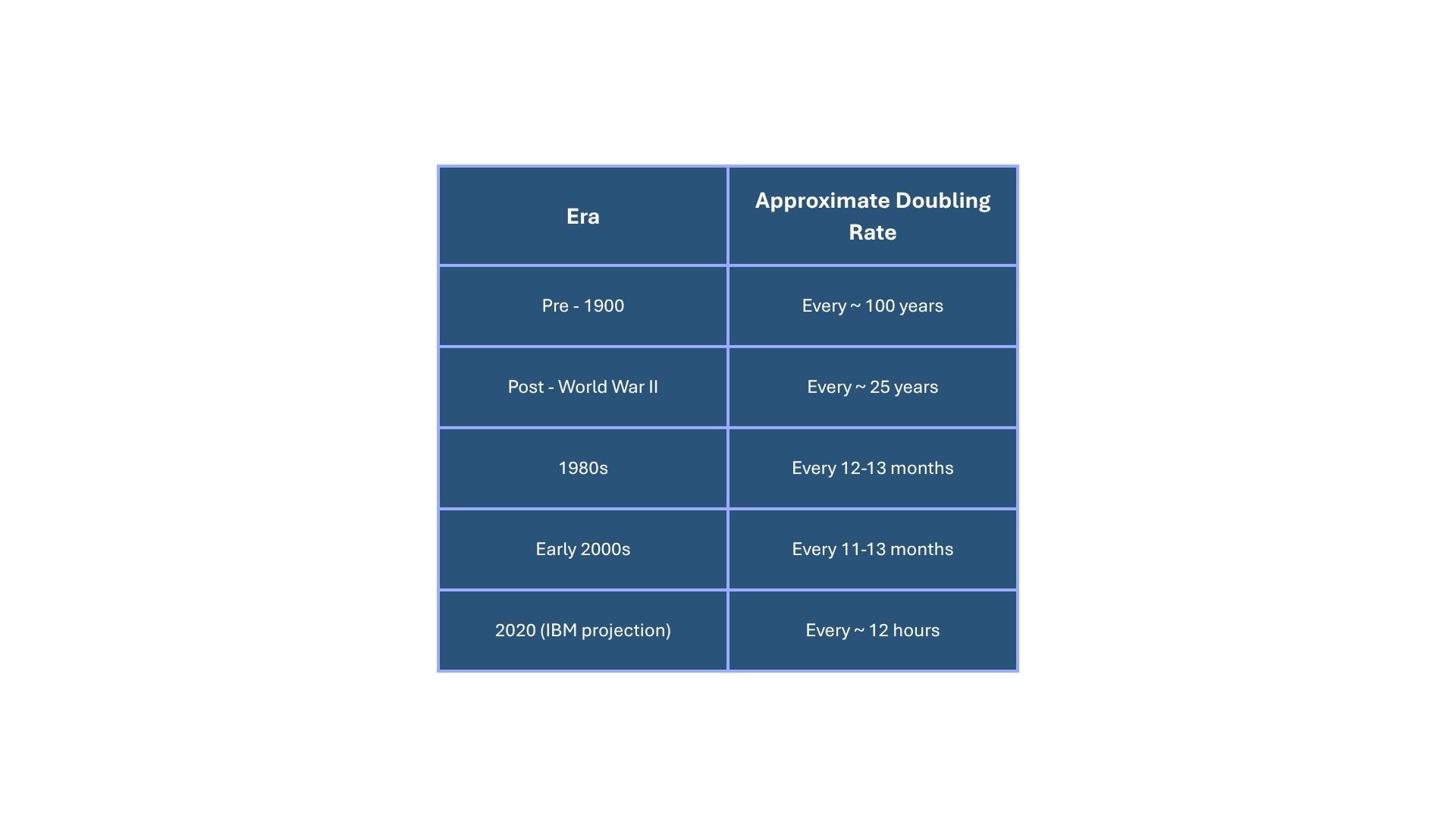
The specific numbers in the doubling curve, particularly the "12 hours" figure attributed to IBM, should be understood as a directional model, not a precise scientific measurement. "Knowledge" doesn’t have an agreed unit of measurement. The IBM projection referred primarily to data volume rather than validated human understanding. What is empirically uncontested is the directional trend: the rate of information generation has accelerated dramatically across every measurable proxy: published papers, patents, indexed web pages, enterprise data volume, and social media output. The specific numbers are illustrative, but the curve is real.
The implication is what matters for leadership: the information environment your decisions must navigate is doubling faster than any human being or institution can process, validate, and act on.
The Cognitive Overload Problem
The human brain is not a scalable information processor. It has hard cognitive limits that evolution built over hundreds of thousands of years and that no amount of ambition, intelligence, or caffeine can override. Research on information overload and decision quality has been building since the 1970s, and the findings are remarkably consistent.
Beyond a threshold, which varies by individual and context but is always finite, additional information does not improve decision quality. It degrades it. The mechanisms are well-documented:
Analysis paralysis arrives when the volume of inputs makes any decision feel incomplete. The leader knows more data is available. More scenarios could be modeled. More stakeholders could be consulted. So, the decision waits and fear and uncertainty set in. It isn’t because waiting is strategically sound, but because the information environment makes certainty feel perpetually one data point away. Getting the wrong answer or providing a misguided recommendation allows this cycle to continue.
Confirmation bias amplification is the counterintuitive consequence of information abundance. More data makes it easier to selectively find support for a predetermined conclusion, because in a sufficiently large dataset, evidence for almost any position can be located. Executives who are already inclined toward a particular decision find that the modern information environment gives them more material to justify it than ever before.
Decision fatigue accumulates across the decision queue. Each additional input to each decision consumes a portion of the finite cognitive resources available in a given day. When the information load across multiple decisions is high, the quality of later decisions degrades. This doesn’t happen because the stakes are lower but because the cognitive capacity available to engage with them has been depleted.
Shortened decision half-life creates a particularly vicious cycle. When the information environment is doubling fast enough, decisions made on today's data can be invalidated tomorrow. Leaders who internalize this dynamic stop committing to decisions. Instead, they are continuously revising, re-examining, and deferring in a loop that consumes organizational energy without producing organizational direction.
The Organizational Consequence: Data Without Trust
The information explosion has produced another problem inside organizations that is less discussed but equally damaging: the proliferation of data has eroded trust in data.
Every technology wave described in Post 1.1 left behind a legacy system, in the form of a database,platform,spreadsheet architecture, or reporting framework. Each new wave ends up layered on top of the previous one rather than replacing it. The result is disconnected data islands: the ERP doesn't talk to the CRM, the logistics platform doesn't connect to the financial reporting system, the customer service database exists in a separate universe from the sales data, and endless excel spreadsheets to analyze and interpret activity and action across those systems.
Bridging these islands falls to people. This may be the most underrated impact of information explosion. Humans become the connective tissue between systems that were never designed to communicate. Humans are manually pulling data, reconciling discrepancies, translating formats, and validating figures that should agree but often don't. They are shepherding data to maintain company functions. When the reconciliation fails, and two or more systems produce two or more different answers to the same question, the person doing the bridgework faces an impossible choice: which number is right? And if neither is reliably right, why trust either?
Gartner estimates that poor data quality costs organizations an average of $12.9 million per year in direct costs alone. The indirect cost of decisions made on flawed data, opportunities missed because no one trusted the numbers enough to act, and time consumed in reconciliation loops, is orders of magnitude larger and almost never measured.
The result is an organization where executives have access to more data than ever, trust it less than ever, and spend more time managing the data environment than using it to make decisions.
What This Means for Leadership Decision-Making
The leaders who navigate the knowledge doubling environment most effectively share a trait that is easy to describe and hard to practice: they invest in information architecture rather than information volume
The distinction is critical. Information volume, as seen in more dashboards, reports, data feeds, and analytical tools, is the default organizational response to the feeling of insufficient insight. It almost never works, because it adds to the cognitive load without improving the signal-to-noise ratio.
Information architecture is a different discipline entirely. It asks: of everything that could be known, what do we need to know to make this decision well? It builds faster pathways to the right data through knowledge management systems, delegated analytical layers, clear decision rights, and AI-assisted synthesis. It accepts that the goal is not to know everything but to trust what you know enough to act on it.
This is a creative leadership challenge, not a technical one. Your organization’s values, objectives, and strategy are what drive the decision-making framework. There isn’t a system that will do it for you and deliver the results required for superior business performance. These are human judgments. They require the kind of deliberate, imaginative thinking that information overload is specifically designed to crowd out. It takes time and effort. You can’t short-cut this work.
The executives who recognize this and understand that their job is to architect information flow rather than simply consume more of it, are the ones who will make better decisions faster than those who do not take on this task.
The Case for Healthy Skepticism
So, how do we reconcile performance differences between data-driven and intuition based decision making? Isn’t data-driven decision making inherently better? As with so many things, the answer is yes and no. The research is clear that data outperforms intuition in specific conditions: well-defined problems, complete datasets, stable environments, bias-prone categories. But intuition outperforms data in other scenarios: novel situations, incomplete information, high-velocity decisions, complex human dynamics.
The information explosion has created a generation of executives who are often over-loaded on data and deficient on judgment. When every decision requires a data justification, organizations systematically underprioritize the decisions that cannot be quantified, such as culture investment, brand positioning, customer relationship depth, and creative strategy. Think about this for a moment. These are areas where the most lasting competitive advantages are built, and where executive creativity is the most irreplaceable input.
The goal is not less data. The goal is better balance. It is knowing when the data leads, versus when the data informs and human judgment decides.
Next in Series 1: "The 60% Problem: What Your People Are Actually Doing All Day" We explore how the information explosion has created a hidden work crisis that is consuming your organization's most valuable resource.
Missed the first post in this series? The Ground Shifted While You Were Managing
Is your leadership team making decisions with the right information, or just more of it? Let's talk. Contact BlueWave for a leadership strategy consultation. Click Here
Visit our website for information on our services.
Follow me on LinkedIn
Visit our blog: BlueWave Insights