
What AI Is Actually Good For
Post 1.4: "What AI Is Good For (Hint: It's Not Replacing Your People)"
The Creative Executive Series
Series 1: The Information Age Has Outpaced Leadership
Published by LeAnne Coulter | BlueWave Supply Chain
The frustrating leadership conversation about artificial intelligence has a way of falling to one question. "How many people can we replace?"
That question misses the point. AI can, in specific and well defined contexts, be deployed to remove people from their roles. But that framing captures only about 10-20% of the value available through AI deployment, leaving 80-90% on the table. Executives who frame AI as a headcount reduction tool are not being strategic. They are being cheap about something expensive and mistaking cost avoidance for value creation.
The right question unlocks the much larger opportunity. "What would this organization be capable of if we reclaimed the 30-60% of human capacity currently consumed by hidden work, bridgework, and information overhead?"
Answering that question requires understanding what AI actually is: a collection of fundamentally different computing methods, not a single monolithic technology. Each method has distinct capabilities, limitations, and appropriate use cases. Executives who lump these methods into a single tool called "AI" will consistently apply the wrong capability to the wrong problem. They wonder why the results don't deliver against their expectations.
Five Distinct AI Methods. What Each One Does
Method 1: Rule-Based Expert Systems (1970s-1990s)
The first commercial AI was not machine learning. It was logic. Expert systems encoded human domain expertise as explicit "if-then" rules. For example, if the patient presents with symptoms A, B, and C, then the diagnosis is D. Those rules were used to simulate specialist judgment at scale.
Expert systems are still in wide use today, though they often aren't recognized as AI at all. They power compliance rule engines, pricing guardrails, workflow routing logic, and automated approval systems in ERP and WMS platforms. Their strength is precision and auditability: the logic is transparent and the decisions can be traced. Their limitation is rigidity. They can only handle situations their rules anticipated. Building comprehensive rule sets for complex domains is enormously expensive, and these systems break down when reality is messier than the experts who designed them originally thought.
Business application today: Rules-based systems are appropriate for high-volume, well-defined decisions with clear logic. Examples include flagging compliance violations, routing customer service tickets, and enforcing procurement approval thresholds. They struggle with anything requiring contextual judgment.
Method 2: Statistical Machine Learning (1990s-2010s)
Statistical machine learning shifted the paradigm from telling the computer the rules to showing the computer enough examples and letting it find the patterns. Algorithms including Bayesian networks, Support Vector Machines, Random Forests, and Gradient Boosting learned from historical data to make predictions about new data.
This is the AI that quietly transformed industries throughout the 2000s without most executives noticing. It powers credit scoring models that approve or decline loan applications in milliseconds. It runs the fraud detection systems that flag suspicious transactions. It optimizes logistics routing, demand forecasting, and inventory positioning in supply chains. At times we need reminders that this is AI. It may not be glamorous, but it's operational at scale, and it has been generating enormous value for companies that deployed it thoughtfully for twenty years.
Business application today:Statistical ML is the mature workhorse of enterprise AI, appropriate for prediction tasks on structured data such as churn prediction, demand forecasting, risk scoring, and price optimization. It requires historical data of sufficient volume and quality, which is why data quality (discussed in Post 1.3) is a prerequisite for capturing its value.
Method 3: Deep Learning (2010s-present)
Deep learning uses multi-layered neural networks to learn from large, complex, often unstructured data. The architectures are loosely inspired by the human brain, and this approach made breakthroughs possible that statistical ML could not achieve.
Computer vision:Reading documents, inspecting products for defects, processing shipping labels, recognizing objects in images and video
Natural language processing:Understanding customer feedback, routing support tickets by content, extracting structured data from unstructured text
Recommendation systems:Personalizing product suggestions, content feeds, and search results at the individual level
Deep learning requires far more data and computational power than statistical ML, but it handles the messy, unstructured reality of most enterprise information environments better than any previous method.
Business application today: Deep learning is appropriate where the inputs are unstructured, like text, images, audio, and video, and where the volume of data is sufficient to train effective models. It is the engine behind most modern document processing, intelligent search, and automated classification systems.
Method 4: Large Language Models (2022-present)
Large Language Models represent the first form of AI that interacts with humans in natural language with enough fluency and contextual understanding to function as a working tool for knowledge workers. ChatGPT's arrival in November 2022 was a technology phenomenon: the fastest consumer application adoption in history, reaching one million users in five days. This was a capability shift that most executives felt personally rather than conceptually.
LLMs can draft, summarize, synthesize, translate, explain, code, analyze, and reason across an extraordinary range of tasks. Their critical limitation is well documented: they can generate confident, fluent, and wrong answers. They can make up information and facts, and even citations. They can hallucinate and escape their "sandboxes." They can introduce bias that humans must then detect. They do not "know" things the way a human expert knows them. Instead, they predict probable text based on patterns in their training data, which makes them powerful assistants and unreliable authorities.
Business application today: LLMs are most valuable for tasks that involve generating, transforming, or summarizing language at scale, such as drafting communications, synthesizing research, explaining complex information, writing code, and navigating documentation. They are the most direct tool for attacking the hidden work problem: the coordination overhead, the search time, the information synthesis burden that consumes 30-60% of knowledge worker capacity. Deployed thoughtfully, an LLM doesn't replace the analyst so much as eliminate the three hours the analyst was spending finding and formatting the inputs so they could do the actual analysis.
Method 5: Agentic AI (2024-present)
Agentic AI is the newest and least mature of the five methods. These are systems capable of autonomous multi-step decision-making, tool use, and task completion without continuous human prompting. An AI agent can be given a goal, such as "research our top five competitors' pricing changes over the last six months and summarize the strategic implications," and execute the necessary steps independently: searching, reading, synthesizing, and producing output.
The potential of agentic AI for business is enormous and the risks are significant. Autonomous systems that make decisions and take actions without human review can amplify errors at the same speed they amplify efficiency. The enterprises that will capture value from agentic AI will be those that deploy it within carefully designed human-in-the-loop architectures. This structure uses agents to handle the mechanical steps of complex workflows while preserving human judgment for the decisions that matter.
Business application today: Early-stage and accelerating. Most appropriate for well-defined workflows with clear success criteria and low consequence of error in individual steps, including research compilation, data gathering, report generation, and supplier monitoring. Requires thoughtful governance frameworks that most organizations are still developing.
The Hidden Work Connection
What unifies these five methods, and what the most effective executives understand about AI that the headcount-focused ones do not, is that the primary value of AI in most enterprise environments comes from overhead elimination, not task replacement.
The hidden work described in Post 1.3, the 30-60% of knowledge worker time consumed by search, bridgework, reconciliation, coordination, and information formatting, is precisely the class of work that AI is most immediately capable of addressing. Consider the specific categories:
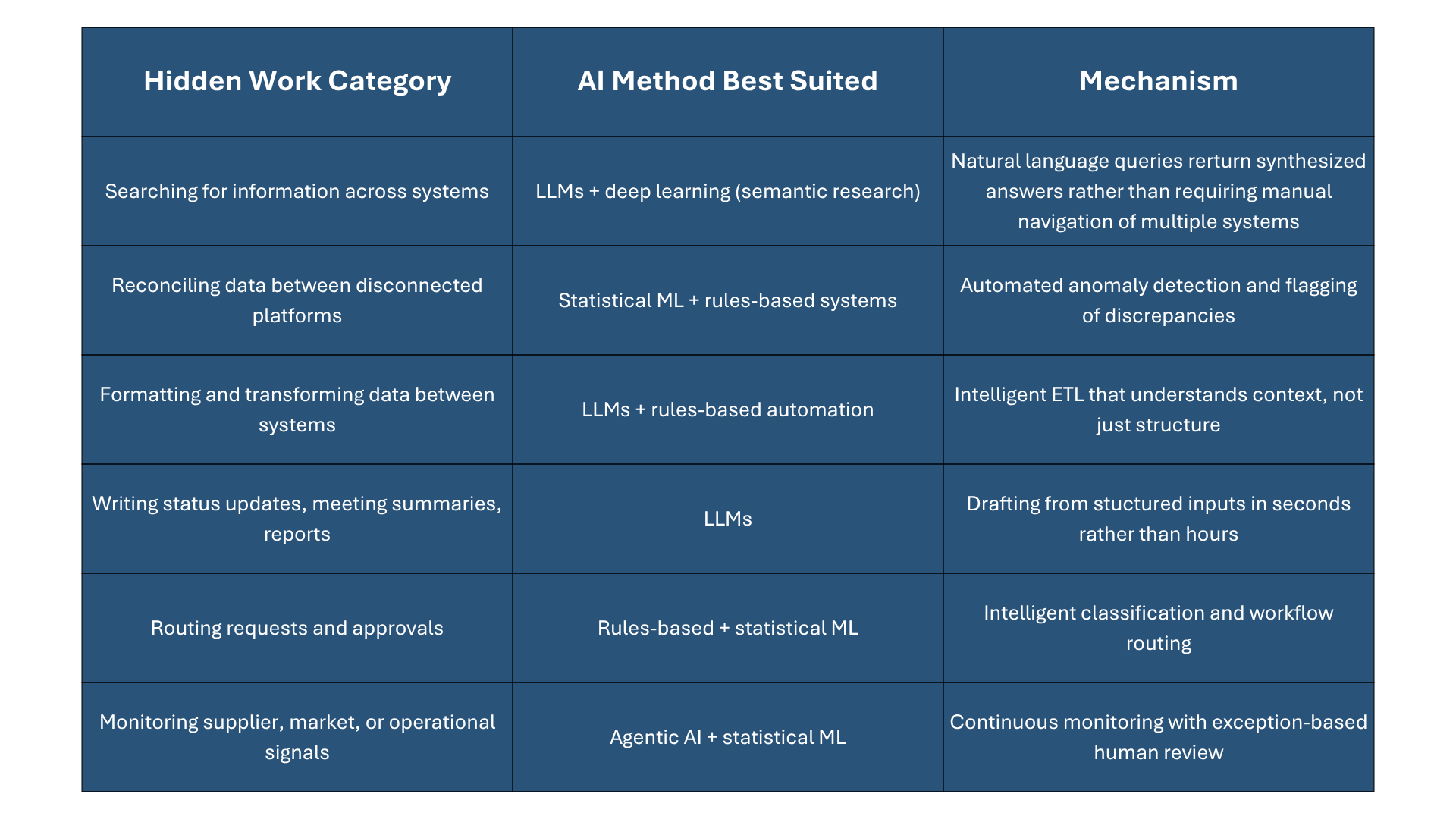
McKinsey estimated that improving knowledge search and flow alone, apart from headcount reduction or wholesale process redesign, simply by making information accessible, could increase knowledge worker productivity by 20-25%. Enterprises deploying AI for process automation in the hidden work layer are achieving 25-45% productivity gains in automated processes within the first year. The three-year ROI for enterprises that successfully deploy AI across multiple value dimensions, beyond cost reduction alone, is 150-300%.
The executives capturing that value are not asking "how many people can AI replace?" They are asking "where is the organizational capacity locked up in overhead, and how do we unlock it so our people can do the work they were actually hired to do?"
Why Executives Misunderstand This
The misframing of AI as a replacement tool rather than an augmentation tool is not accidental. It is the product of the same short-termism that drives the broader cost-cutting instinct described earlier in this series. Headcount reduction is visible, immediate, and easy to model in a spreadsheet. The value of reclaiming 30% of organizational capacity and redirecting it toward customer-facing, growth-oriented work is real but harder to quantify on the timeline of the next earnings call or monthly P&L review.
Only 13% of enterprises can effectively quantify the business value of their AI investments. This means 87% are making AI decisions without a measurement framework that captures the full value available. Executives who cannot measure the value of reclaimed cognitive capacity will consistently underinvest in the AI applications that deliver it.
The organizations that are getting this right are deploying AI as a capability amplifier rather than a cost lever. They are giving their people better tools to do more valuable work, reclaiming the hours lost to overhead, and redirecting that capacity toward the customer relationships, creative problem-solving, and growth initiatives that AI cannot do on its own. The Stanford-Deloitte research found that companies viewing humans as "value creators to augment" outperformed those viewing humans as "costs to reduce" by 22% across key financial metrics over five years.
That 22% advantage isn't coming from the AI itself. It's coming from the executives who asked the right question about it.
The Synthesis
This is where the four posts of Series 1 converge. The ground shifted, and technology transformation cycles compressed to the point where organizations no longer have a stable interval in which to adapt. The information explosion that accompanied those shifts has overwhelmed the cognitive architecture of leadership decision-making, creating paralysis, bias, and distrust. The hidden work crisis that resulted is consuming 30-60% of organizational capacity in overhead that produces no customer or margin value. AI, properly understood as five distinct methods with distinct capabilities, is the most powerful tool available for reclaiming that capacity and redirecting it toward the creative, growth-oriented, human work that machines cannot do.
The executives who understand this sequence are not the ones being kept up at night by AI. They are the ones who see clearly, perhaps for the first time, what it would mean to run an organization where the people they lead are doing the work they were hired to do, supported by tools that are finally equal to the task.
That understanding is the beginning of creative leadership. The next series will examine what separates the executives who act on it from those who don't.
Series 2 begins next: "Two Kinds of Executives," the financial case for growth thinking over cost thinking, and why the math that drives headcount reductions is borrowing from your company's future.
Curious what percentage of your team’s capacity is locked in hidden work that AI could reclaim? Schedule a call with BlueWave to find out. Schedule Time
Visit our website for information on our services.
Follow me on LinkedIn
Visit our blog: BlueWave Insights
Missed the third post in this series? "The 60% Problem: What Your People Are Actually Doing All Day"