
The 60% Problem: Hidden Work Consuming Your Organization
Post 1.3 "The 60% Problem: What Your People Are Actually Doing All Day"
Series 1: The Information Age Has Outpaced Leadership
Published by LeAnne Coulter | BlueWave Supply Chain
Here is a question worth asking. If you could observe how your organization's time is truly being spent today, what would you find?
This is harder than you may initially think. Don’t use the obvious tools, such as your performance management system report, your productivity dashboards, not even what your direct reports tell you during your one on one meetings for your answers. What you are seeking is what is really happening, hour by hour, across the people you are paying to create value for your customers and your shareholders.What is happening that keeps the wheels from falling off your company. What really makes it function?
The research has an answer. And for most executives, it is deeply uncomfortable.
What the Data Shows
Multiple independent research streams, conducted across different methodologies, years, and organizational contexts, converge on the same essential finding. A substantial portion of knowledge worker time is consumed by work that produces no direct customer or margin value. That number is between 30%-60% of workers’ time.
Asana's Anatomy of Work Index, conducted annually with 10,000+ knowledge workers globally through independent research firms, has consistently found that approximately 60% of knowledge worker time is spent on "work about work". This is coordination activities, status updates, searching for information, switching between tools, attending meetings about work rather than doing work, and duplicating effort that already exists somewhere in the organization.
IDC research identified that 30% of the average workday, or roughly 2.5 hours, is spent searching for information. McKinsey's independent research found a similar figure: 1.8 hours per day consumed by searching and gathering information. A separate IDC study found that 36% of worker time is spent consolidating information spread across multiple disconnected systems.
To be precise about what these numbers measure and how they relate to each other:
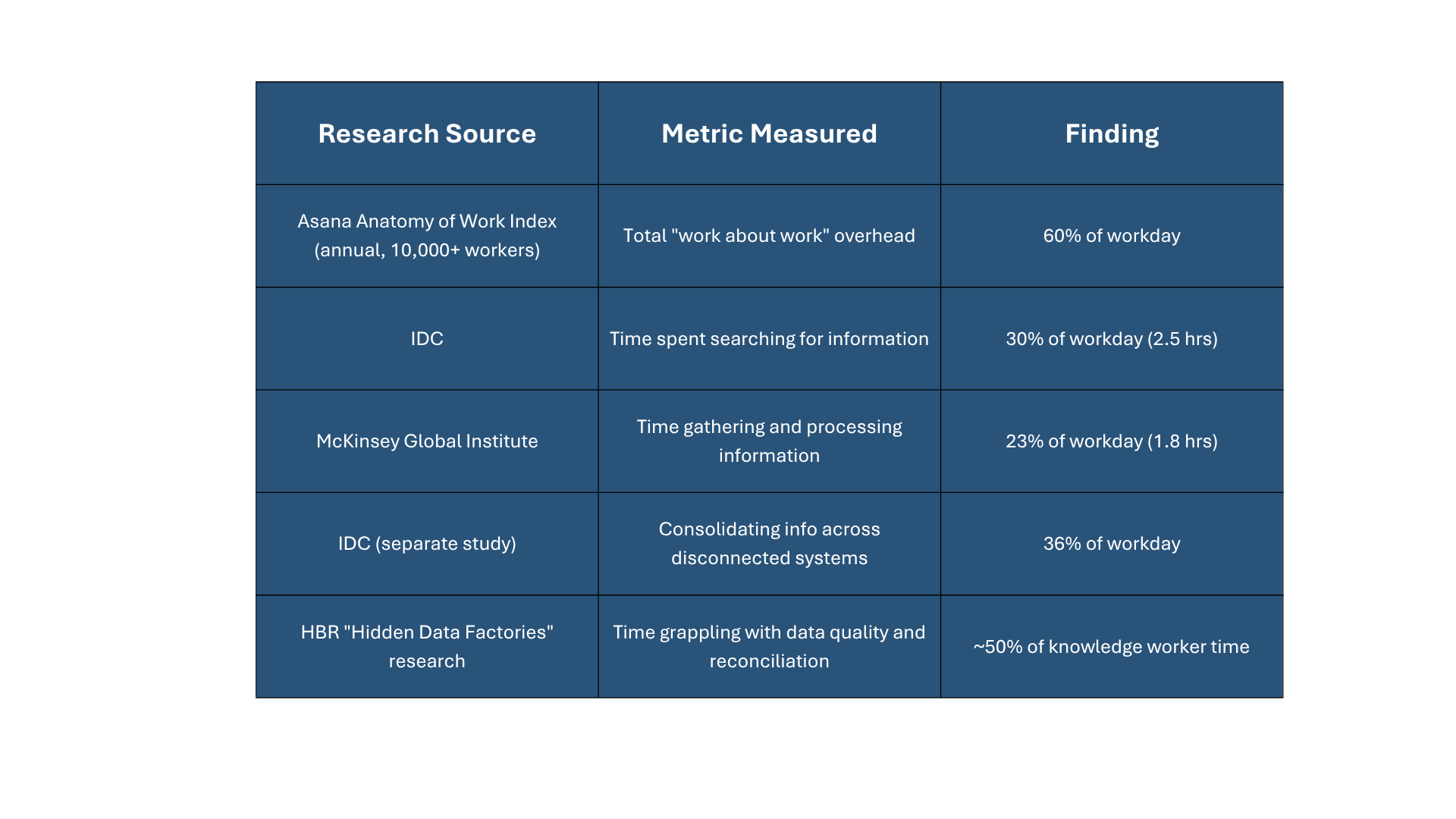
The 30% and 60% figures are measuring different scopes of the same problem. They are not contradicting each other. The lower number captures the pure search and retrieval problem. The upper number captures the full overhead: coordination, reconciliation, duplication, status reporting, and all the administrative work that orbits the actual task a person was hired to perform.
Translated into annual hours, Asana's research found the average knowledge worker spends:
103 hours per year in unnecessary meetings
209 hours per year on duplicative work
352 hours per year talking about work rather than doing it
That is approximately 664 hours per year, or roughly 16 full work weeks, consumed by hidden work.
Where This Hidden Work Actually Comes From
Understanding the source of hidden work is essential to addressing it, because the instinct of most cost-focused executives is to attack it by reducing headcount. That instinct is wrong, and the data on why it is wrong will be addressed directly in Series 2. For now, the more important question is: Why does this hidden work exist in the first place?
The answer connects directly to the technology eras described in Post 1.1 and the information explosion described in Post 1.2. Hidden work is not a function of individual inefficiency. It is a structural consequence of how organizations have accumulated technology over decades without rationalizing the information architecture underneath it.
The Legacy Layer Problem
Every technology wave left sediment. Organizations that have been operating for twenty or more years typically carry an ERP system, a CRM platform, a logistics management system, a financial reporting infrastructure, multiple spreadsheet environments, and a growing array of SaaS tools. None of thesewere designed to share data cleanly with the others. The gaps between these systems are filled by people. People who manually export data from one system and import it into another. People who maintain reconciliation spreadsheets that translate between systems using different definitions of the same metric. People who know that the number in the dashboard is wrong and can tell you the right one. They know thisbecause they spent years building the institutional knowledge to identify the discrepancy. They built the Access databases and the Excel spreadsheets to reduce some of the friction they encounter. They still must do this. If not, the wheels fall off.
This is bridgework. It is invisible on any org chart. It is rarely in anyone's job description. And it consumes enormous quantities of organizational capacity that could otherwise be directed toward customers, products, and growth.
The Data Distrust Cascade
We have all experienced data distrust. When bridgework fails, meaningwhen two systems produce two different answers, or when a reconciliation error cascades into a flawed report, the response is typically not to fix the underlying architecture. It is to add another layer of manual verification, a second check, a parallel process,or a "sanity review" before any number goes to leadership. Each of these verification layers is rational in isolation and collectively catastrophic at scale.
Gartner's research estimates that poor data quality costs organizations an average of $12.9 million per year. The Cambridge Spark analysis of data quality costs found that organizations lose an average of 30% of revenue to poor quality data through bad decisions, missed opportunities, and process failures. These are real costs. They are embedded in the operating model of most organizations and have been there for years. They have been normalized into invisibility.
The Meeting and Coordination Tax
The IDC's research on time spent searching for information increased 13% between 2002 and 2013 alone. This was during a period of moderate data growth and has accelerated sharply since. As data volumes grew, systems proliferated, and as remote and hybrid work removed the informal knowledge-sharing that happened in physical proximity, the formal coordination overhead grew to compensate. Meetings exist, in large part, because people cannot find reliable information any other way. Status updates exist because no one trusts the system of record enough to read it without confirmation. One error happens and executives demand a full audit. Duplicate work exists because no one can easily discover what has already been done.
The meeting load is not a culture problem at its core, though it is often diagnosed as one. It is an information architecture problem wearing a culture costume.
The Supply Chain View
The people in your organization who are most likely to recognize this diagnosis from lived experience areexecutives in logistics, supply chain, and operations. For these people, the hidden work problem has a specific and acute manifestation.
Supply chains are, by definition, multi-system environments. A typical mid-to-large enterprise operates transportation management systems, warehouse management systems, demand planning platforms, procurement tools, supplier portals, and financial systems. Each system generating data, each using slightly different definitions of "on-time delivery" or "inventory accuracy" or "landed cost," and none of them natively integrated. The people who make supply chains function are, the people who have learned to navigate this fragmentation manually.
When an executive in this environment proposes headcount reduction, they are often proposing the elimination of the institutional knowledge that holds the system together. The person who gets cut is not just a salary. They are the living bridge between three systems that don't communicate. When they leave, the bridge collapses. No one fully understands why things stop working until they've stopped working at considerable cost.
This is the hidden cost of hidden work. It is invisible until it is gone.
The Executive Blind Spot
The 60% problem has been hiding in plain sight for years, but it persists because of a specific failure of executive visibility. What leaders typically measure, such as revenue per employee, units per hour, calls handled per agent, captures productive output but not the overhead surrounding it. An employee spending 60% of their time on hidden work and 40% on value-creating work may appear, by output metrics, to be performing adequately. What is invisible is that the same person, in an organization with a rational information architecture, might produce two or three times the value-creating output in the same hours.
McKinsey's research estimated that improving knowledge search and flow alone, and not through headcount reduction, process redesign, or strategic repositioning, but simply making it easier for people to find and use the information they need could increase knowledge worker productivity by 20–25%. That is a significant margin expansion opportunity available in most large organizations right now, without hiring a single additional person or cutting any existing ones.
The question is not whether the opportunity exists. The question is whether the executive sees it.
What Seeing It Actually Requires
Recognizing the 60% problem as a structural issue rather than an individual performance issue requires a form of organizational creativity that is different from, and in some ways harder than, financial creativity. It requires the willingness to look at how work is organized, and not how it is supposed to be organized according to the last restructuring memo.It is also to honestly ask whether the architecture of information flow in the organization is enabling or inhibiting the people who work within it.
It requires what the most effective leaders in high-information environments do instinctively: investing in the infrastructure of insight rather than simply demanding more output from the people operating within a broken one.
The next post in this series examines the tool that is most often misidentified as the solution to the headcount problem. Itis the solution to the hidden work problem. It is something everyone grapples with, and what creates fear in your organization. It is artificial intelligence. This distinction matters enormously for the executives who will shape its deployment.
Next in Series 1: "What AI Is Actually Good For (Hint: It's Not Replacing Your People)" We are reframing AI's value as a hidden-work elimination engine and understanding the five distinct computing methods that executives are currently conflating into one blunt instrument.
How much of your team's capacity is locked in overhead? BlueWave can help you find and reclaim it. Click Here
Visit our website for information on our services.
Follow me on LinkedIn
Visit our blog: BlueWave Insights
Missed the second post in this series? You’re Drowning in Data and Starving for Insight